
In part one, on thinking machines, I explored two facets of the philosophy of artificial intelligence: “intelligence”, and consciousness. That left an important topic to consider for this post: the impact of artificial intelligence on work.
No technology has ever “stolen a job”. Not once. Technology automates and enables tasks. Some of these tasks were never part of “the market”, and other tasks were. If your job is defined by performing the same task over and over, be it knocking the base of a saggar, driving a vehicle, or typing JavaScript into somebody else’s computer, and that task can be automated, then there’s a chance that your employers won’t need you to do that task any more. But whether they keep you, redeploy you, retrain you to do something else, or let you go, is their choice: it’s the employers that stole your job.
Let’s imagine a hypothetical scenario where a company has ten JavaScript shovelers, and each outputs an average of one bushel of JS per day. Now some technological intervention—could be AI, sure, but it could be a syntax-highlighting text editor, TypeScript, or some other tool—makes each JS shoveler ten times more efficient (aside: it doesn’t). The employer’s choices (note: not the technology’s choices, not the inventor’s choices; the employer’s choices) might be represented in a diagram like this:
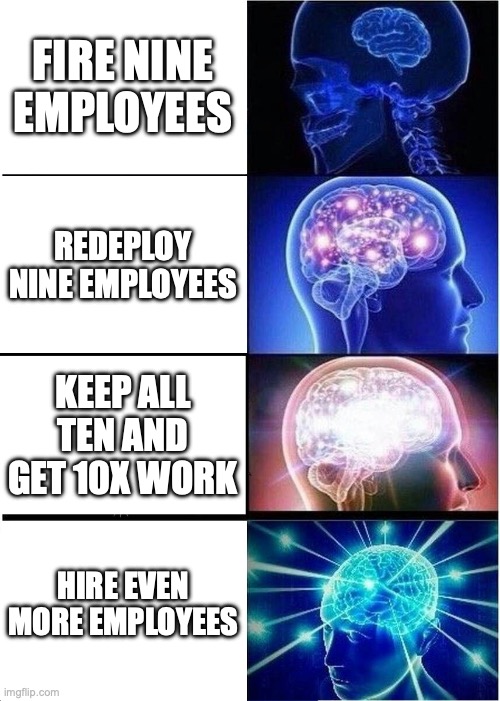
That last option is courtesy of Jevons’ paradox, which says that when a resource becomes more efficient to use, demand goes up. If a new technology makes knowledge-deployment more efficient, then demand for knowledge work increases, it doesn’t decrease. The employers who don’t increase their knowledge-working capacity when knowledge work becomes more efficient are, to paraphrase William Stanley Jevons, idiots.
The “AI is stealing our jobs” meme comes from a lack of understanding that software engineers are workers, not employers, and that the economic principles of employment and work apply to them the same as to other workers. Bringing in another paradox of economics, Robert Solow noted that “you can see the computer age everywhere but in the productivity statistics”. It took a long time for computers to start automating knowledge work: first record tabulation, then payroll and inventory management, then the typing pool and typesetting, then so on and so on through technical drafting and taxi dispatching.
Through the slow burn of the computer age, software engineers got comfortable with being the people who automate other people’s work. Throughout that period, demand for (the task of) computer programming rose. Now, two (mostly unrelated) things have happened: the first is that a new technology has promised to automate computer programming, placing us at the start of the next Solow age; and headcount among people who repetitively do computer-programming tasks has been decreasing.
That means that the computer people are on the receiving end of capitalism for the first time since the dot-com crash, and they don’t like it. We automate other people’s work, it’s unfair to automate our work! This is another view through the same economic lens that gives us enshittification: wait, we worked hard to turn this manual task into an automated platform, you owners can’t seriously expect to capture additional value from this platform?! We’re supposed to continue to benefit from the lower costs we enabled for you!?
Those of us who do computering for a salary, wage, or day rate have always been on the receiving end of the exploitative nature of the wage relationship, unfortunately the relatively high salaries and enjoyable tasks stopped many of us from engaging with that seriously. We’re now in a position of huge uncertainty for many employees in the field, and the short-term solution to that is the same solution it’s always been, that’s demonstrated to work in many European economies: collective bargaining on behalf of the sector.
But becoming conscious to the benefits of increasing bargaining power through group organisation is insufficient to end the fundamentally exploitative relationship, and to stop the next round of automation, layoffs, and changes to employment conditions. So is any idea that employment will automatically disappear completely, or ebb away, in some Keynesian decline to a 15-hour working week. As we automate some tasks, we introduce new tasks, and new jobs that exploit people to get those tasks done; whether or not you think of them as bullshit jobs.



I think this is one of the most interesting — and least heard of — arguments about software people losing jobs. Thanks for writing this up! (I landed here from indieblog, BTW!)
I’m going to think about what kind of jobs software enginers have automated in the past where workers in other sectors have lost jobs as a direct ‘impact’ of such automations. It’s given me an interesting topic to ponder more about!