
There’s a situation in evolutionary biology called valley crossing. That’s when a more advantageous adaptation for organisms in a species can only be reached by intermediate adaptations that are less advantageous than the current genotype.
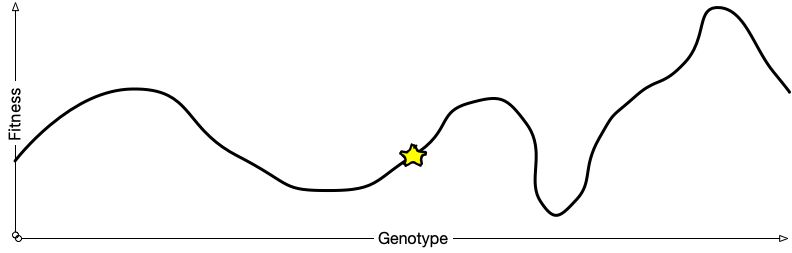
If the species currently sits at the star, it’s relatively easy for natural selection to tend to push things to the right over time, until it approaches the nearby peak. Individuals whose genotypes drift left are less well-adapted to their environment than those at the star or to the right of the star. But then natural selection struggles to “cross the valley” to the even more suitable adaptations at the higher peak; getting there involves intermediate steps with worse outcomes.
Your products and processes behave like this too, if you take timid, incremental steps towards improvement. Continuous improvement can show you when a nearby state seems better, but when a nearby state seems worse you won’t pass through it on the way to a greater reward.
Sometimes, continuous, iterative improvement needs a helping hand; someone needs to throw an asteroid at the system and see what shakes out. Of course, you don’t literally destroy your product or your development team. You experiment, simulate, and explore. What would happen if we stopped doing this? How would things change if we did this instead? What would customers think of this different direction?
Almost all of these experiments fail, and that’s fine, it’s learning. The ones that don’t fail provide the breakthroughs that help you explore the map without crossing those treacherous valleys.